To Bless the Space Between Us
by John O'Donohue
In out-of-the-way places of the heart,
Where your thoughts never think to wander,
This beginning has been quietly forming,
Waiting until you were ready to emerge.
For a long time it has watched your desire,
Feeling the emptiness growing inside you,
Noticing how you willed yourself on,
Still unable to leave what you had outgrown.
It watched you play with the seduction of safety
And the gray promises that sameness whispered,
Heard the waves of turmoil rise and relent,
Wondered would you always live like this.
Then the delight, when your courage kindled,
And out you stepped onto new ground,
Your eyes young again with energy and dream,
A path of plenitude opening before you.
Though your destination is not yet clear
You can trust the promise of this opening;
Unfurl yourself into the grace of beginning
That is at one with your life's desire.
Awaken your spirit to adventure;
Hold nothing back, learn to find ease in risk;
Soon you will be home in a new rhythm,
For your soul senses the world that awaits you.
"Every day the glory is ready to emerge from its debasement."
~Rabbi Nachman of Bratslav
Sunday, January 24, 2010


Monday, January 11, 2010
Meditation on The Epiphany: Baptism of Christ (Luke 3:22)

"...and the Holy Spirit descended upon him
in bodily form like a dove"
Things are not as they seem: the innuendo of everything makes
itself felt and trembles towards meanings we never intuited
or dreamed. Take, for example, how the warbler, perched on a
mere branch, can kidnap the day from its tediums and send us
heavenwards, or how, held up by nothing we really see, our
spirits soar and then, in a mysterious series of twists and turns,
come to a safe landing in a field, encircled by greenery. Nothing
I can say to you here can possibly convince you that a man
as unreliable as I have been can smuggle in truths between tercets
and quatrains on scraps of paper, but the world as we know
is full of surprises, and the likelihood that here, in the shape
of this very bird, redemption awaits us should not be dismissed
so easily. Each year, days swivel and diminish along their inscrutable
axes, then lengthen again until we are bathed in light we were not
prepared for. Last night, lying in bed with nothing to hold onto
but myself, I gazed at the emptiness beside me and saw there, in the
shape of absence, something so sweet and deliberate I called it darling.
No one who encrusticates (I made that up!) his silliness in a bowl,
waiting for sanctity, can ever know how lovely playfulness can be,
and, that said, let me wish you a Merry One (or Chanukah if you
prefer), and may whatever holds you up stay forever beneath you,
and may the robin find many a worm, and our cruelties abate,
and may you be well and happy and full of mischief as I am,
and may all your nothings, too, hold something up and sing.
"And the Cantilevered Inference Shall Hold the Day"
by Michael Blumenthal
Wednesday, December 16, 2009
Advent Meditation (Is 52:10)
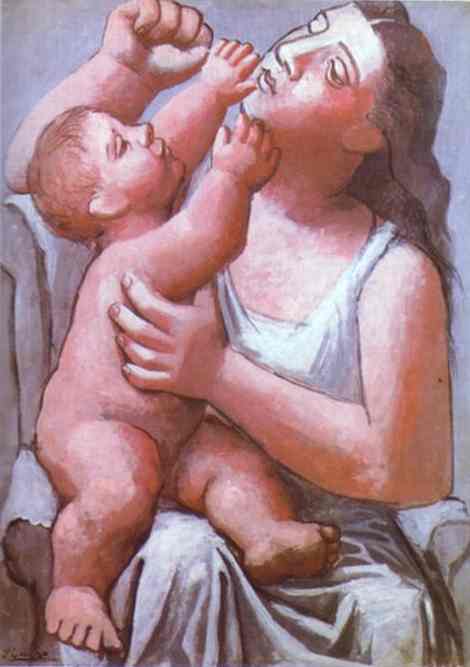
Pablo Picasso. Mother and Child. 1921-22.
. . .
Among the most familiar Christmas texts is the one in Isaiah: "The Lord himself will give you a sign. Behold, a young woman shall conceive and bear a son, and shall call his name Immanuel" (7:14) Less familiar is its context: Isaiah has been pleading with King Ahaz to put his trust in God’s promise to Israel rather than in alliances with strong military powers like Syria. "If you will not believe, you shall not be established," Isaiah warns Ahaz (7:9). Then the prophet tells the fearful king that God is going to give him a baby as a sign. A baby. Isn’t that just like God, Ahaz must have thought. What Ahaz needed, with Assyria breathing down his neck, was a good army, not a baby.
This is often the way God loves us: with gifts we thought we didn’t need, which transform us into people we don’t necessarily want to be. With our advanced degrees, armies, government programs, material comforts and self-fulfillment techniques, we assume that religion is about giving a little, of our power in order to confirm to ourselves that we are indeed as self-sufficient as we claim.
This is often the way God loves us: with gifts we thought we didn’t need, which transform us into people we don’t necessarily want to be. With our advanced degrees, armies, government programs, material comforts and self-fulfillment techniques, we assume that religion is about giving a little, of our power in order to confirm to ourselves that we are indeed as self-sufficient as we claim.
Then this stranger comes to us, blesses us with a gift, and calls us to see ourselves as we are -- empty-handed recipients of a gracious God who, rather than leave us to our own devices, gave us a baby. ~William Willimon From a God We Hardly Knew
. . .
Who has believed our report? and to whom is the arm of the LORD revealed? (Is 53:1)
He that is mighty has done great things for me, and holy is His name. His mercy is on those who fear Him from generation to generation. He has shown strength with His arm; He has scattered the proud in the imagination of their hearts. He has overthrown the mighty from their thrones, and exalted the lowly. He has filled the hungry with good things, and the rich He has sent away empty. (Lk 1:49-53 - Mary's Song)
The LORD has made bare his holy arm in the eyes of all the nations; and all the ends of the earth shall see the salvation of our God. (Is 52:10)
He that is mighty has done great things for me, and holy is His name. His mercy is on those who fear Him from generation to generation. He has shown strength with His arm; He has scattered the proud in the imagination of their hearts. He has overthrown the mighty from their thrones, and exalted the lowly. He has filled the hungry with good things, and the rich He has sent away empty. (Lk 1:49-53 - Mary's Song)
The LORD has made bare his holy arm in the eyes of all the nations; and all the ends of the earth shall see the salvation of our God. (Is 52:10)
Monday, November 16, 2009
Paying attention to the Poet
These messages in a bottle are from Bill Holm, Minnesota-born author, musician, and scholar.
Wedding Poem For Schele and Phil
A marriage is risky business these days
Says some old and prudent voice inside.
We don't need twenty children anymore
To keep the family line alive,
Or gather up the hay before the rain.
No law demands respectability.
Love can arrive without certificate or cash.
History and experience both make clear
That men and women do not hear
The music of the world in the same key,
Rather rolling dissonances doomed to clash.
So what is left to justify a marriage?
Maybe only the hunch that half the world
Will ever be present in any room
With just a single pair of eyes to see it.
Whatever is invisible to one
Is to the other an enormous golden lion
Calm and sleeping in the easy chair.
After many years, if things go right
Both lion and emptiness are always there;
The one never true without the other.
But the dark secret of the ones long married,
A pleasure never mentioned to the young,
Is the sweet heat made from two bodies in a bed
Curled together on a winter night,
The smell of the other always in the quilt,
The hand set quietly on the other's flank
That carries news from another world
Light-years away from the one inside
That you always thought you inhabited alone.
The heat in that hand could melt a stone.
-----
Advice
Someone dancing inside us
has learned only a few steps:
the "Do-Your-Work" in 4/4 time,
the "What-Do-You-Expect" Waltz.
He hasn't noticed yet the woman
standing away from the lamp.
the one with black eyes
who knows the rumba.
and strange steps in jumpy rhythms
from the mountains of Bulgaria.
If they dance together,
something unexpected will happen;
if they don't, the next world
will be a lot like this one.
Wedding Poem For Schele and Phil
A marriage is risky business these days
Says some old and prudent voice inside.
We don't need twenty children anymore
To keep the family line alive,
Or gather up the hay before the rain.
No law demands respectability.
Love can arrive without certificate or cash.
History and experience both make clear
That men and women do not hear
The music of the world in the same key,
Rather rolling dissonances doomed to clash.
So what is left to justify a marriage?
Maybe only the hunch that half the world
Will ever be present in any room
With just a single pair of eyes to see it.
Whatever is invisible to one
Is to the other an enormous golden lion
Calm and sleeping in the easy chair.
After many years, if things go right
Both lion and emptiness are always there;
The one never true without the other.
But the dark secret of the ones long married,
A pleasure never mentioned to the young,
Is the sweet heat made from two bodies in a bed
Curled together on a winter night,
The smell of the other always in the quilt,
The hand set quietly on the other's flank
That carries news from another world
Light-years away from the one inside
That you always thought you inhabited alone.
The heat in that hand could melt a stone.
-----
Advice
Someone dancing inside us
has learned only a few steps:
the "Do-Your-Work" in 4/4 time,
the "What-Do-You-Expect" Waltz.
He hasn't noticed yet the woman
standing away from the lamp.
the one with black eyes
who knows the rumba.
and strange steps in jumpy rhythms
from the mountains of Bulgaria.
If they dance together,
something unexpected will happen;
if they don't, the next world
will be a lot like this one.
Tuesday, September 01, 2009
September 1, 1939
 This poem has haunted me for years ever since I read it for the first time shortly after September 11, 2001. According to this morning's Writer's Almanac it "became one of Auden's most famous poems, but in later years he rejected it. He refused to give permission for it to be in anthologies, and when he did include it, he either changed 'We must love one another or die' to 'we must love one another and die,' or he took out the stanza entirely.."
Have to wonder why. Got any clues? By my sights that and tends to lend a mobius twist to that already remarkable line. But to consider taking it out? Even rejecting his work entirely? That gives me pause. What was he thinking? Sounds like it was something of a torment for him. Well, he was a poet for Christ's sake. And an Anglican at that. Anglicans eat ambivalence like popcorn.
The line that especially rings for me is the error bred in the bone... not universal love, but to be loved alone. Talk about adding a mobius-loopy twist to things. Got me thinking about double helixes (DNA among others) and alternate universes. Flesh and Spirit. When all I really want to do at the moment is have a little lighter-hearted fun with my friends - in the face of it all. Go figure. In the world we shall have tribulation. But be of good cheer...
There yet remaineth a place for good old-fashioned pretzels and beer. And thou. Blithe and bonny and bon vivant. As my 11 year old daughter Maggs recently wrote, "Yay! I'm... be! Yay!!"
It was on this day in 1939 that Nazi Germany invaded Poland, and World War II began. How tempting is it now to reduce the world to a worry bead.
September 1, 1939 by W.H. Auden
I sit in one of the dives
On Fifty-second street
Uncertain and afraid
As the clever hopes expire
Of a low dishonest decade:
Waves of anger and fear
Circulate over the bright
and darkened lands of the earth,
Obsessing our private lives;
The unmentionable odour of death
Offends the September night.
Accurate scholarship can
unearth the whole offence
From Luther until now
That has driven a culture mad,
Find what occurred at Linz,
What huge imago made
A psychopathic god:
I and the public know
What all schoolchildren learn,
Those to whom evil is done
Do evil in return.
Exiled Thucydides knew
All that a speech can say
About Democracy,
And what dictators do,
The elderly rubbish they talk
To an apathetic grave;
Analysed all in his book,
The enlightenment driven away,
The habit-forming pain,
Mismanagement and grief:
We must suffer them all again.
Into this neutral air
Where blind skyscrapers use
Their full height to proclaim
The strength of Collective Man,
Each language pours its vain
Competitive excuse:
But who can live for long
In an euphoric dream;
Out of the mirror they stare,
Imperialism¹s face
And the international wrong.
Faces along the bar
Cling to their average day:
The lights must never go out,
The music must always play,
All the conventions conspire
To make this fort assume
The furniture of home;
Lest we should see where we are,
Lost in a haunted wood,
Children afraid of the night
who have never been happy or good.
The windiest militant trash
Important Persons shout
Is not so crude as our wish:
What mad Nijinsky wrote
About Diaghilev
Is true of the normal heart;
For the error bred in the bone
Of each woman and each man
Craves what it cannot have,
Not universal love
But to be loved alone.
From the conservative dark
Into the ethical life
The dense commuters come,
Repeating their morning vow,
"I will be true to the wife.
I'll concentrate more on my work,"
And helpless governors wake
To resume their compulsory game:
Who can release them now,
Who can reach the deaf,
Who can speak for the dumb?
All I have is a voice
To undo the folded lie,
The romantic lie in the brain
Of the sensual man-in-the-street
And the lie of Authority
Whose buildings grope the sky:
There is no such thing as the State
And no one exists alone;
Hunger allows no choice
To the citizen or the police;
We must love one another or die.
Defenceless under the night
Our world in stupor lies;
Yet, dotted everywhere,
Ironic points of light
Flash out wherever the Just
Exchange their messages;
May I, composed like them
Of Eros and of dust,
Beleaguered by the same
Negation and despair,
Show an affirming flame.
-- W. H. Auden
Friday, August 28, 2009
Saturday, July 04, 2009
Friday, June 26, 2009
Tuesday, May 26, 2009
Good words for today
The following is from James E. Dittes' Driven By Hope: Men and Meaning. I'm putting it here as both an anchor and a reminder to myself:
Men make promises and know keenly the anguish of finding them unkept. We are reminded relentlessly of our failures to others. But men also believe promises and know the keener anguish of finding them unkept, notably the promise that we can live our own life fully and freely. It is a powerful engine, the sorrow of living with that promise unmet.
The Bible tells it clearly, from the beginning: paradise wanting. Adam looked around Eden and asked, Is that all there is? The sorrow of incompleteness is man's from the outset part of creation, not a symptom of sin or fall; just as the sorrow of a blameless life cut short on a cross reveals redemption, not sin. This sorrow of incompleteness, life chronically destined, is what is offered to man as the avenue to wholeness and holiness. Life in want; life detoured, in a closet, a gift not yet unwrapped - this must be the most relentless theme of the Bible, recounted in its many rich variations: faithful affirmation of what lies in store, an affirmation so vivid it measures excruciatingly the deficit at hand.
The Bible shouts (and whispers) the triumphant story of men's wanting: Life is abundant and authentic, but not yet.
. . .
What does a man want? Sigmund Freud never directed to men that famous vexed and impatient question, "What do women want?" He seems to have thought, like most of us, that a real man doesn't "want" or that a real man, if he does find himself in want, doesn't yield to it, but renounces and conquers any "wanting." But he was wrong. So we all are when we bravely pretend otherwise, that we don't want for anything and that to be in want doesn't hurt painfully. Men do live in want, and what we want is not so mysterious or so unseemly. A man, like anyone else, wants to live his own life and to live it fully: life authentic and abundant. Every man's chronic sorrow is for his unlived life. Conquering that sorrow comes to claim every man's prime energies. But it will not be quelled, and the stratagems to defy it or deny it only lead to further distortions, the more notable distortions, the ones that most invite rebuke and regret.
. . .
Sorrow is like grief but more lasting. A man doesn't outlive sorrow the way he can outlive grief. He must simply live out the sorrow. Grief looks backward and can be outlived by looking forward. Grief is the soul wrenched by loss of what once was. It can gradually be let go. Grief abates; sorrow persists. Sorrow looks ahead and mourns what appears missing as far as one can see, the divergence between life visible and life intended. Sorrow is the soul teased. Is that all there is?
. . .
Living in want is not an injury to be fixed, an accident to be recovered from, an ill-fitting garment to be shed. It is not acquired, not optional, not the product of an individual life history. It is decidely not a flaw to be atoned for. Living in want is constituent of what it means to be a man, a product of man's spiritual genes. Men are supposed to live in want, in deep spiritual hunger, in the shadows of their own destiny, desperately hopeful. It is a part of manhood to be welcomed, embraced, lived by, not against. A man is more of a man, not less, for living in want. Sorrow and shadows belong to the order of creation, not to the Fall. And they belong, too, to the process of re-deeming, where we encounter the paradoxical power of finding one's own life by losing it, the power that sorrow and shadows deliver.
Deepest in the belly is not fire but ache.
Men make promises and know keenly the anguish of finding them unkept. We are reminded relentlessly of our failures to others. But men also believe promises and know the keener anguish of finding them unkept, notably the promise that we can live our own life fully and freely. It is a powerful engine, the sorrow of living with that promise unmet.
The Bible tells it clearly, from the beginning: paradise wanting. Adam looked around Eden and asked, Is that all there is? The sorrow of incompleteness is man's from the outset part of creation, not a symptom of sin or fall; just as the sorrow of a blameless life cut short on a cross reveals redemption, not sin. This sorrow of incompleteness, life chronically destined, is what is offered to man as the avenue to wholeness and holiness. Life in want; life detoured, in a closet, a gift not yet unwrapped - this must be the most relentless theme of the Bible, recounted in its many rich variations: faithful affirmation of what lies in store, an affirmation so vivid it measures excruciatingly the deficit at hand.
The Bible shouts (and whispers) the triumphant story of men's wanting: Life is abundant and authentic, but not yet.
. . .
What does a man want? Sigmund Freud never directed to men that famous vexed and impatient question, "What do women want?" He seems to have thought, like most of us, that a real man doesn't "want" or that a real man, if he does find himself in want, doesn't yield to it, but renounces and conquers any "wanting." But he was wrong. So we all are when we bravely pretend otherwise, that we don't want for anything and that to be in want doesn't hurt painfully. Men do live in want, and what we want is not so mysterious or so unseemly. A man, like anyone else, wants to live his own life and to live it fully: life authentic and abundant. Every man's chronic sorrow is for his unlived life. Conquering that sorrow comes to claim every man's prime energies. But it will not be quelled, and the stratagems to defy it or deny it only lead to further distortions, the more notable distortions, the ones that most invite rebuke and regret.
. . .
Sorrow is like grief but more lasting. A man doesn't outlive sorrow the way he can outlive grief. He must simply live out the sorrow. Grief looks backward and can be outlived by looking forward. Grief is the soul wrenched by loss of what once was. It can gradually be let go. Grief abates; sorrow persists. Sorrow looks ahead and mourns what appears missing as far as one can see, the divergence between life visible and life intended. Sorrow is the soul teased. Is that all there is?
. . .
Living in want is not an injury to be fixed, an accident to be recovered from, an ill-fitting garment to be shed. It is not acquired, not optional, not the product of an individual life history. It is decidely not a flaw to be atoned for. Living in want is constituent of what it means to be a man, a product of man's spiritual genes. Men are supposed to live in want, in deep spiritual hunger, in the shadows of their own destiny, desperately hopeful. It is a part of manhood to be welcomed, embraced, lived by, not against. A man is more of a man, not less, for living in want. Sorrow and shadows belong to the order of creation, not to the Fall. And they belong, too, to the process of re-deeming, where we encounter the paradoxical power of finding one's own life by losing it, the power that sorrow and shadows deliver.
Deepest in the belly is not fire but ache.
Sunday, May 03, 2009
God Bless the Poets
This one's another keeper (that speaks of both bones and trees in the same breath):
In Blackwater Woods, by Mary Oliver
Look, the trees
are turning
their own bodies
into pillars
of light,
are giving off the rich
fragrance of cinnamon
and fulfillment,
the long tapers
of cattails
are bursting and floating away over
the blue shoulders
of the ponds,
and every pond,
no matter what its
name is, is
nameless now.
Every year
everything
I have ever learned
in my lifetime
leads back to this: the fires
and the black river of loss
whose other side
is salvation,
whose meaning
none of us will ever know.
To live in this world
you must be able
to do three things:
to love what is mortal;
to hold it
against your bones knowing
your own life depends on it;
and, when the time comes to let it go,
to let it go.
In Blackwater Woods, by Mary Oliver
Look, the trees
are turning
their own bodies
into pillars
of light,
are giving off the rich
fragrance of cinnamon
and fulfillment,
the long tapers
of cattails
are bursting and floating away over
the blue shoulders
of the ponds,
and every pond,
no matter what its
name is, is
nameless now.
Every year
everything
I have ever learned
in my lifetime
leads back to this: the fires
and the black river of loss
whose other side
is salvation,
whose meaning
none of us will ever know.
To live in this world
you must be able
to do three things:
to love what is mortal;
to hold it
against your bones knowing
your own life depends on it;
and, when the time comes to let it go,
to let it go.
Wednesday, April 15, 2009


Friday, April 03, 2009
Into each life a little Leonard Cohen must fall...
A Street by Leonard Cohen
I used to be your favorite drunk
Good for one more laugh
Then we both ran out of luck
And luck was all we had
You put on a uniform
To fight the Civil War
I tried to join but no one liked
The side I’m fighting for
So let’s drink to when it’s over
And let’s drink to when we meet
I’ll be standing on this corner
Where there used to be a street
You left me with the dishes
And a baby in the bath
And you’re tight with the militias
You wear their camouflage
I guess that makes us equal
But I want to march with you
An extra in the sequel
To the old red-white-and-blue
So let’s drink to when it’s over
And let’s drink to when we meet
I’ll be standing on this corner
Where there used to be a street
I cried for you this morning
And I’ll cry for you again
But I’m not in charge of sorrow
So please don’t ask me when
I know the burden’s heavy
As you bear it through the night
Some people say it’s empty
But that doesn’t mean it’s light
So let’s drink to when it’s over
And let’s drink to when we meet
I’ll be standing on this corner
Where there used to be a street
It’s going to be September now
For many years to come
Every heart adjusting
To that strict September drum
I see the Ghost of Culture
With numbers on his wrist
Salute some new conclusion
Which all of us have missed
So let’s drink to when it’s over
And let’s drink to when we meet
I’ll be standing on this corner
Where there used to be a street
I used to be your favorite drunk
Good for one more laugh
Then we both ran out of luck
And luck was all we had
You put on a uniform
To fight the Civil War
I tried to join but no one liked
The side I’m fighting for
So let’s drink to when it’s over
And let’s drink to when we meet
I’ll be standing on this corner
Where there used to be a street
You left me with the dishes
And a baby in the bath
And you’re tight with the militias
You wear their camouflage
I guess that makes us equal
But I want to march with you
An extra in the sequel
To the old red-white-and-blue
So let’s drink to when it’s over
And let’s drink to when we meet
I’ll be standing on this corner
Where there used to be a street
I cried for you this morning
And I’ll cry for you again
But I’m not in charge of sorrow
So please don’t ask me when
I know the burden’s heavy
As you bear it through the night
Some people say it’s empty
But that doesn’t mean it’s light
So let’s drink to when it’s over
And let’s drink to when we meet
I’ll be standing on this corner
Where there used to be a street
It’s going to be September now
For many years to come
Every heart adjusting
To that strict September drum
I see the Ghost of Culture
With numbers on his wrist
Salute some new conclusion
Which all of us have missed
So let’s drink to when it’s over
And let’s drink to when we meet
I’ll be standing on this corner
Where there used to be a street
Wednesday, March 25, 2009
Sap's rising again
These two music videos resonate with me this season. Got my key.
Some kind of energy there...
Some kind of energy there...
Monday, March 16, 2009
Monday morning musings
I thought this was kind of poetic:
And this morning's offering from The Writer's Almanac seemed rather timely, too - the last line especially hit home:
Cold Poem by Jim Harrison
A cold has put me on the fritz, said Eugene O'Neill,
how can I forget certain things?
Now I have thirteen bottles of red wine
where once I had over a thousand.
I know where they went but why should I tell?
Every day I feed the dogs and birds.
The yard is littered with bones and seed husks.
Hearts spend their entire lives in the dark,
but the dogs and birds are fond of me.
I take a shower frequently but still
women are not drawn to me in large numbers.
Perhaps they know I'm happily married
and why exhaust themselves vainly to seduce me?
I loaned hundreds of thousands of dollars
and was paid back only by two Indians.
If I had known history it was never otherwise.
This is the song of the cold when people
are themselves but less so, people
who haven't listened to my unworded advice.
I was once described as "immortal"
but this didn't include my mother who recently died.
And why go to New York after the asteroid
and the floods of polar waters, the crumbling
buildings, when you're the only one there
in 2050? Come back to earth.
Blow your nose and dwell on the shortness of life.
Lift up your dark heart and sing a song about
how time drifts past you like the gentlest, almost
imperceptible breeze.
And this morning's offering from The Writer's Almanac seemed rather timely, too - the last line especially hit home:
Cold Poem by Jim Harrison
A cold has put me on the fritz, said Eugene O'Neill,
how can I forget certain things?
Now I have thirteen bottles of red wine
where once I had over a thousand.
I know where they went but why should I tell?
Every day I feed the dogs and birds.
The yard is littered with bones and seed husks.
Hearts spend their entire lives in the dark,
but the dogs and birds are fond of me.
I take a shower frequently but still
women are not drawn to me in large numbers.
Perhaps they know I'm happily married
and why exhaust themselves vainly to seduce me?
I loaned hundreds of thousands of dollars
and was paid back only by two Indians.
If I had known history it was never otherwise.
This is the song of the cold when people
are themselves but less so, people
who haven't listened to my unworded advice.
I was once described as "immortal"
but this didn't include my mother who recently died.
And why go to New York after the asteroid
and the floods of polar waters, the crumbling
buildings, when you're the only one there
in 2050? Come back to earth.
Blow your nose and dwell on the shortness of life.
Lift up your dark heart and sing a song about
how time drifts past you like the gentlest, almost
imperceptible breeze.
Monday, January 26, 2009

Friday, January 23, 2009
Happy Birthday, Rabbie
Had our annual Nicht Wi' Rabbie Burns at church tonight. There was haggis, tatties 'n neeps, shortbread, lots of toasts, pipers and dancers and songs and poems. I got to read the two above. The house was full and jumpin'. Such fun!
If you've a mind to here's a short bio on the man Robert Burns: An Appreciation on the Occasion of His 250th Birthday.
His poems and songs can be found here.
Thursday, January 01, 2009
2009
Dedicated to those who missed a midnight kiss
And ther's a hand, my trusty friend,
And gie's a hand o' thine;
We'll tak' a cup o' kindness yet...
Happy You Near, my dears and dahlinks!
And ther's a hand, my trusty friend,
And gie's a hand o' thine;
We'll tak' a cup o' kindness yet...
Happy You Near, my dears and dahlinks!
Monday, December 15, 2008
Monday, December 01, 2008
Wordle up!
This could be fun! Have you checked out Wordle? Any body of text, either copypasta-ed or via URL (if it has an Atom or RSS feed) be it articles, blog posts, sermons, propaganda, love letters - anything textual - it creates a condensed "word cloud" out of it. Kind of a visual representation of a document's word count.
I wordled my blog and got this:

Pretty cool!
Now you show me yours!
I wordled my blog and got this:
Pretty cool!
Now you show me yours!
Friday, November 28, 2008
Holidays
Well, it's that time of year again. Thanksgiving's over and now Advent begins once more. From the top. Adagio con brio. What may turn up this year I wonder? Depends on the key, I suppose.
To help set the tone I return once more to my two favorite poems for the season; Mary's Song, by Lucy Shaw, and this one which seems especially poignant this year:
Christmas Fills the Empty Chair
by Connie J. Hessevick
Christmas reminds me of Grandma
winters of lefse, krumkake, fattimand...
My father’s memories
handed down through my imagination
bring me the Grandma I never met
to share Göd Jul
I sit at the table
in a house fresh with baking
you offer me coffee or lingonberry wine
homemade lefse unrolled from checkered towels
Butter?
Sugar?
Five boys fill your home
the eldest son tall, pink and hearty
labors at the wood pile
the steady sounds of axe to wood
our music for the evening
My young father on the quilt
turns the pages of a book
you are stern with him
he’ll not damage the pictures of the Old Land
slim heritage of a young bride bound for America
Norsk woman’s pride stares squarely at the Proctor son
a son who smiles his blue grey eyes
gingerly turns another page
and knows it is a holiday
Two round faced boys burst in from the cold
snow deep in every fold of their bundling
you help them inside out
seat them chattering by the stove
give hot milk and chocolate shavings
as they begin their "What if..." game
"Just what if snow came down as milk and chocolate?"
I share your thoughts on things the boys don’t hear
of the youngest son
in the Proctor earth now
of the empty chair
Just what if their father would knock on the door
Just what if he had not worked on the railroad
Just what if he had not tried to unionize
if he had not been black balled
would he be here now?
Or would he have gone for other reasons
as he had gone from Norway
we can share this story of men
who have reason to go
and not enough reason to return
We turn to warm milk and hard tack
and ease the slow burning in our bellies
The evening stills
And the thin son lights the candles on the tree
Makes shadows of his father around the room
All of the family
Gathered together
For a Christmas Eve
Just as you join me
fill my empty chair
bringing the family together again
I sprinkle the fattimand with powdered sugar
and offer you coffee
Milk?
Sugar?
Reprinted with permission from "Gentle Spirit" magazine.
To help set the tone I return once more to my two favorite poems for the season; Mary's Song, by Lucy Shaw, and this one which seems especially poignant this year:
Christmas Fills the Empty Chair
by Connie J. Hessevick
Christmas reminds me of Grandma
winters of lefse, krumkake, fattimand...
My father’s memories
handed down through my imagination
bring me the Grandma I never met
to share Göd Jul
I sit at the table
in a house fresh with baking
you offer me coffee or lingonberry wine
homemade lefse unrolled from checkered towels
Butter?
Sugar?
Five boys fill your home
the eldest son tall, pink and hearty
labors at the wood pile
the steady sounds of axe to wood
our music for the evening
My young father on the quilt
turns the pages of a book
you are stern with him
he’ll not damage the pictures of the Old Land
slim heritage of a young bride bound for America
Norsk woman’s pride stares squarely at the Proctor son
a son who smiles his blue grey eyes
gingerly turns another page
and knows it is a holiday
Two round faced boys burst in from the cold
snow deep in every fold of their bundling
you help them inside out
seat them chattering by the stove
give hot milk and chocolate shavings
as they begin their "What if..." game
"Just what if snow came down as milk and chocolate?"
I share your thoughts on things the boys don’t hear
of the youngest son
in the Proctor earth now
of the empty chair
Just what if their father would knock on the door
Just what if he had not worked on the railroad
Just what if he had not tried to unionize
if he had not been black balled
would he be here now?
Or would he have gone for other reasons
as he had gone from Norway
we can share this story of men
who have reason to go
and not enough reason to return
We turn to warm milk and hard tack
and ease the slow burning in our bellies
The evening stills
And the thin son lights the candles on the tree
Makes shadows of his father around the room
All of the family
Gathered together
For a Christmas Eve
Just as you join me
fill my empty chair
bringing the family together again
I sprinkle the fattimand with powdered sugar
and offer you coffee
Milk?
Sugar?
Reprinted with permission from "Gentle Spirit" magazine.
Subscribe to:
Posts (Atom)